GUÐRÚN ÓSVÍFRSDÓTTIR: PRIDE, LOVE, VENGEANCE, AND MEMORY IN LAXDÆLA SAGA
When we read the Icelandic sagas, we are not merely following old stories of quarrels, marriages, voyages, and killings. We are probing into the lives of people in the sagas: their loyalties, their pride, their errors, their moments of greatness, and the hidden wounds that drive them. Few figures reward that kind of close attention more than Guðrún Ósvífrsdóttir of Laxdæla saga. She is one of the most vivid women in all Old Norse literature: beautiful, brilliant, proud, wounded, calculating, loyal to honor, and finally marked by sorrow and religious transformation.
Guðrún is traditionally placed in the late tenth and early eleventh centuries. She was born around 973 at Laugar in Sælingsdalur, in western Iceland, and died around 1060 at Helgafell on Snæfellsnes. The saga presents her not as a supporting figure in a male heroic world, but as one of the central forces shaping the destiny of families, chieftains, lovers, and sons. She is praised for beauty and intelligence, but her story is not a simple romance. It is a study in how love, status, insult, and vengeance can become entangled until no one emerges untouched.

Lineage and Character
Guðrún was the daughter of Ósvífr Helgason and Þórdís Þjóðólfsdóttir. Her family lived at Laugar, or “Bathstead” in older English translations, near the hot springs in Sælingsdalur. The saga introduces her in striking terms: she is the fairest of women in Iceland, exceptional not only in appearance but also in intelligence, speech, skill, and generosity. In saga language, such descriptions are never casual decoration. They establish social power. Beauty matters, but wit, speech, and bearing matter more. Guðrún is dangerous because she is not merely desired; she understands people.
Her father Ósvífr is depicted as a wise man, and Guðrún’s household is socially significant. She is surrounded by brothers, retainers, kin, and dependent figures who later become instruments in the saga’s feuds. But from the beginning, Guðrún stands apart. She is not passive material to be exchanged in marriage. Even when men formally arrange her life, she interprets, resists, manipulates, and eventually directs events.
The Four Dreams: Fate Announced Before It Happens
One of the most important scenes in Guðrún’s life comes before her major marriages unfold. She meets the wise man Gestr Oddleifsson at the baths and tells him four dreams. These dreams are symbolic and prophetic, each representing one of her future husbands.

In the first dream, she wears an ill-fitting headdress or coif, dislikes it, and casts it away into water. Gestr interprets this as her first marriage: a husband she will not love, whom she will eventually leave.
In the second dream, she wears a silver ring, treasures it, but loses it into water. This foretells her second husband, whom she will love more than the first, but lose by drowning.
In the third dream, she wears a gold ring, more precious than the silver one. It breaks, and she sees blood in the fragments. Gestr reads this as her third marriage: a more significant husband, connected with the coming change of faith, who will be killed. He also suggests that, after his death, she will see the flaws in that marriage more clearly.
In the fourth dream, she wears a heavy golden helmet set with precious stones. It is magnificent but burdensome, and it falls from her head into Hvammsfjörður. Gestr interprets this as her fourth husband, a powerful chieftain whose authority will weigh upon her, and who will die by drowning in that fjord.
This dream-sequence is one of the great pieces of psychological foreshadowing in the saga. Guðrún hears her life before she lives it. Yet hearing fate does not free her from it. That is one of the saga’s deepest lessons. In Norse storytelling, foreknowledge is not always liberation. Sometimes it is a tightening noose.
First Marriage: Þorvaldr Halldórsson
Guðrún’s first husband is Þorvaldr Halldórsson of Garpsdalur. She is about fifteen when the match is arranged at the Althing. Her father Ósvífr manages the settlement, and Guðrún is not truly consulted. The marriage is unequal in emotional and social force from the beginning. Þorvaldr is wealthy enough, but he is no great man, and Guðrún does not love him.
The terms of the marriage are revealing. Guðrún is to control the household goods and own half the property whether the marriage lasts long or short. She is also allowed to purchase fine jewelry suitable to her rank. This becomes one of the weapons by which she expresses contempt. She demands costly ornaments and grows angry when Þorvaldr resists. Eventually, he strikes her.
Guðrún’s response is cold, controlled, and memorable. Rather than respond with helplessness, she interprets the blow as an opportunity. With the counsel of Þórðr Ingunnarson, she engineers a legal divorce by making Þorvaldr a shirt with a neckline so low that it gives technical grounds for separation. The detail may seem comic, but it reveals a crucial saga reality: law, clothing, gender norms, and honor are all connected. Guðrún’s revenge is not physical; it is legal and social. She exits the marriage richer and more powerful than she entered it.
This first marriage fulfills the first dream: the ill-fitting head covering is thrown away.
Second Marriage: Þórðr Ingunnarson
Guðrún’s second husband is Þórðr Ingunnarson, the man who had helped her escape her first marriage. Their relationship begins in ambiguity. While she is still married to Þorvaldr, rumors arise of affection between Guðrún and Þórðr. Then Guðrún encourages Þórðr to divorce his wife Auðr on the grounds that she wears breeches like a man. The saga presents this as a sharp and manipulative legal move, and Auðr later retaliates with extraordinary boldness, riding to Þórðr’s bed and wounding him with a short sword or sax.
Guðrún and Þórðr marry, and this marriage appears happier than the first. The saga says their life together is good. But happiness in Laxdæla saga is rarely secure. Þórðr becomes involved in legal action against sorcerers who have wronged his mother. The sorcerers raise a storm by magic, and Þórðr’s ship is wrecked. He drowns, fulfilling the second dream: the silver ring slips away into water.
Guðrún is pregnant at the time. She gives birth to a son named Þórðr, later called Þórðr Cat, who is fostered by Snorri goði. This is important because Snorri becomes one of the great strategic presences in Guðrún’s later life. He is adviser, manipulator, ally, and sometimes the cold mind behind the next move.
Kjartan and Bolli: The Love That Breaks the World
The emotional center of Guðrún’s story is her bond with Kjartan Óláfsson and the tragedy involving Bolli Þorleiksson.
Kjartan is the son of Óláfr pái, or Olaf Peacock, one of the most admired men in the saga. Kjartan is portrayed as almost supernaturally gifted: handsome, strong, generous, accomplished, beloved, and greater than other men in nearly every way. Bolli, his foster-brother and kinsman, is also impressive, but he stands in Kjartan’s shadow. The two are raised together and love one another deeply. That intimacy is what makes the later tragedy so devastating.
Kjartan often visits the baths at Sælingsdalur, where Guðrún is present. The saga says that people considered Kjartan and Guðrún the best match among the young people of their generation. Their attraction is based not merely on beauty but on equality of mind and bearing. They recognize one another. Yet Kjartan decides to go abroad, and Guðrún asks to go with him. He refuses, telling her to wait three years. She refuses to promise it.
This is one of the great turning points. Kjartan wants her fidelity without granting her partnership in the journey. Guðrún, proud and self-knowing, will not bind herself under those terms. Here the saga gives us a woman whose sense of worth is absolute. She may love Kjartan, but she will not become a silent object left behind.
In Norway, Kjartan and Bolli become caught in the politics of King Óláfr Tryggvason and the Christian conversion. Kjartan remains longer in Norway, while Bolli returns to Iceland. Bolli tells Guðrún of Kjartan’s high honor at court and of rumors concerning Kjartan and Ingibjörg, the king’s sister. Whether Bolli intends deception, self-protection, or half-truth, his report wounds Guðrún. Bolli then seeks Guðrún’s hand.
At first, she refuses, saying she will marry no man while Kjartan lives. But pressure from Ósvífr and the logic of family alliance eventually carry the match forward. Guðrún marries Bolli. The saga says that Bolli receives little kindness from her early in the marriage. This detail matters. She has not chosen him with a whole heart. She has entered a marriage shaped by pride, wounded love, family pressure, and perhaps the feeling that Kjartan has abandoned or slighted her.
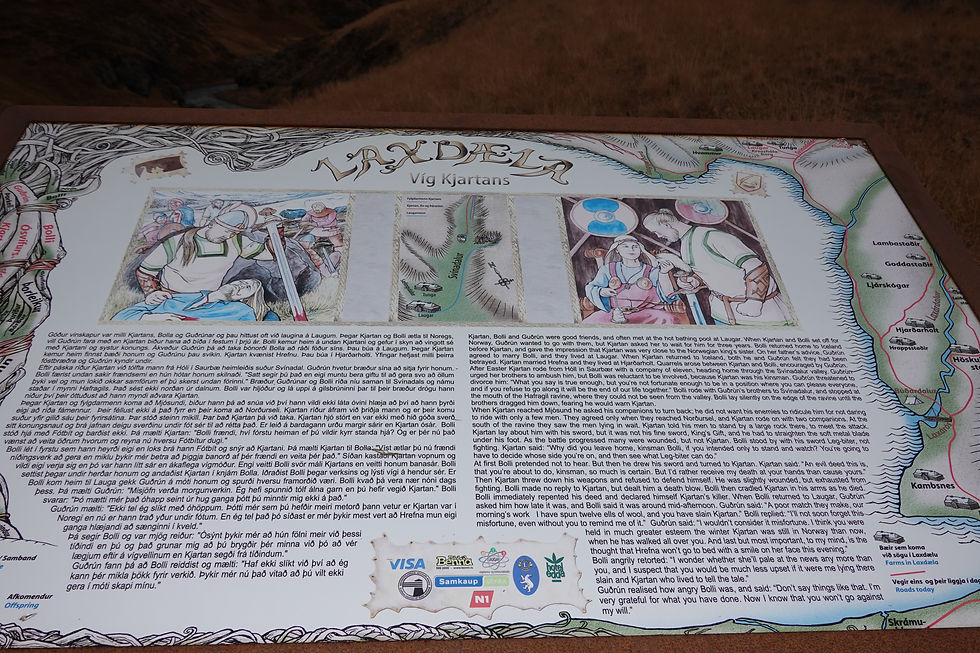
When Kjartan returns to Iceland and learns of the marriage, the emotional field becomes poisonous. He later marries Hrefna, and the famous headdress or wimple given by Ingibjörg becomes a symbol of rivalry between Guðrún and Hrefna. A series of insults and thefts follows. Kjartan’s sword is stolen and hidden. Hrefna’s magnificent wimple disappears and is believed by many to have been burned at Guðrún’s instigation. Kjartan retaliates by surrounding Guðrún’s household and preventing them from leaving to use the outhouse for three days. This is not a killing, but it is a deliberate public humiliation.
To modern readers, the episode may seem crude or almost comic. In saga terms, it is deadly serious. Honor has been attacked. Household dignity has been violated. Guðrún does not forget.
The Incitement and Death of Kjartan
Guðrún then becomes the driving force behind the attack on Kjartan. When Kjartan rides with few companions, she wakes her brothers and shames them for inaction. She tells them, in effect, that they sleep like men without honor while Kjartan rides nearby vulnerable. When Bolli hesitates because of his foster-brotherhood with Kjartan and his debt to Olaf Peacock, Guðrún raises the stakes: their marriage will not continue if he refuses.
This is one of the hardest moments in the saga. Guðrún understands Bolli’s emotional bonds and cuts through them. She does not physically wield the weapon, but she moves men toward violence with speech. In saga society, whetting—inciting men to avenge dishonor—is a recognized and powerful form of action. Guðrún is not a passive instigator in the background. She is a strategist of honor.
The ambush unfolds at Goatgill. Kjartan fights with extraordinary courage. Bolli initially stands aside, but under pressure from the sons of Ósvífr and the logic of the feud, he finally enters. Kjartan refuses to defend himself against Bolli, saying it is better to receive death from him than to give it. Bolli strikes the fatal blow, and Kjartan dies in his arms.
The aftermath is one of the saga’s most psychologically charged scenes. Bolli is immediately stricken with remorse. Guðrún, by contrast, initially frames the killing as an achievement. Yet the saga complicates any simple reading. Is she triumphant? Is she masking grief? Is she avenging insult, punishing Hrefna, punishing Kjartan, punishing herself? The answer may be all of these at once.
Later, near the end of her life, when asked which man she loved most, Guðrún gives the famous answer that she was worst to the one she loved most. This is usually taken to mean Kjartan. If so, the entire tragedy becomes even darker: she destroys the man she most loves because pride, jealousy, social humiliation, and fate have twisted love into vengeance.
Third Marriage: Bolli Þorleiksson
Bolli is Guðrún’s third husband, the gold ring of the dream. He is a great man, and he belongs to the Christian transition, having been baptized abroad with Kjartan. Yet the ring breaks, and blood flows. Their marriage is marked by the shadow of Kjartan’s death. Bolli has gained Guðrún, but at the cost of killing the man she may have loved most and the foster-brother he loved deeply.
After Kjartan’s death, Olaf Peacock prevents immediate revenge against Bolli, but the peace cannot hold forever. After Olaf dies, his widow Þorgerðr Egilsdóttir relentlessly incites her sons to avenge Kjartan. Like Guðrún, Þorgerðr uses shame as a weapon. She taunts her sons for failing to act. The saga thereby gives us not one but two formidable women who refuse to let blood-debt disappear.
Bolli is eventually attacked at the summer shieling (A shieling is a seasonal summer pasture settlement — usually a small hut, cabin, or group of huts up in higher grazing land where people took livestock during the warmer months). Guðrún is with him. Hearing the attackers arrive, Bolli sends her away, and she goes to wash linen at the stream. Bolli defends himself fiercely, but he is overwhelmed. Helgi Harðbeinsson pierces him with a spear, and Steinthor cuts off his head.
Then comes one of the most famous images in the saga. Guðrún returns from the stream and asks what has happened. Helgi wipes Bolli’s blood from his spear on the end of her scarf. Guðrún looks at him and smiles. Halldor rebukes Helgi for the act, calling it cruel and unmanly. Helgi senses danger in the smile and predicts that beneath that scarf is the one who will bring about his death.
The smile is chilling. It is not forgiveness. It is not lightness. It is memory taking form. Guðrún is pregnant with Bolli’s son. That unborn child will become part of the machinery of revenge.
Mother of Vengeance
After Bolli’s death, Guðrún gives birth to Bolli Bollason. She already has an older son, Þorleik Bollason. The boys grow up under the memory of their father’s killing. For years, Guðrún waits. Then, when Bolli Bollason is twelve, she shows her sons their father’s bloody clothes. She does not need a long speech. The garments themselves accuse them. They “cry out” for vengeance.
This is one of the clearest scenes of saga memory as ritual. Bloodied cloth becomes testimony. A mother becomes the keeper of a wound until her sons are old enough to carry it. Guðrún is not simply angry; she is patient. She understands timing. She knows boys must become men before revenge can be made meaningful.
With Snorri’s counsel, the vengeance is redirected toward Helgi Harðbeinsson, the man who dealt Bolli the spear wound. Thorgils Hallason leads the expedition, and Guðrún’s sons take part. Helgi is killed, and Bolli’s death is avenged. Yet even here, the saga shows Guðrún’s strategic mind. Thorgils expects marriage to Guðrún as reward for leading the vengeance. Guðrún’s promise is carefully worded: she will marry no man in Iceland other than him. She later marries Þorkell Eyjólfsson, who is abroad when the promise is made. Technically, she keeps the letter of her word while defeating its expectation.
This is Guðrún at her most politically dangerous. She can use law, language, marriage, insult, and memory as weapons.
Fourth Marriage: Þorkell Eyjólfsson
Guðrún’s fourth husband is Þorkell Eyjólfsson, a wealthy and powerful chieftain. This is the golden helmet of the dream: magnificent, heavy, and finally lost in the water. Their marriage is arranged with Snorri’s support after Bolli has been avenged and Thorgils is dead. Guðrún hosts the wedding at Holyfell herself, refusing to let others bear the burden. Snorri remarks on her pride, and rightly so. Guðrún’s pride is not vanity. It is the principle by which she governs her life.
Þorkell and Guðrún’s marriage appears strong. He becomes a major figure in the region, and they have a son, Gellir. Þorkell plans to build a church and sails to Norway for timber. He obtains great church-timbers from King Olaf, but in a moment of pride refuses to shorten them when the king suggests they are too large. The king predicts that little good will come of the timber.
Þorkell returns to Iceland but later drowns while transporting the wood across Breiðafjörður. Before the news is confirmed, Guðrún has a supernatural vision at Holyfell: she sees figures wet with seawater, as if Þorkell and his men have returned from the deep. Once again, water fulfills the dream. The heavy golden helmet has fallen into the fjord.
Guðrún at Helgafell: Faith, Sorrow, and the Last Answer
After Þorkell’s death, Guðrún turns deeply toward Christianity. The saga says she becomes intensely religious, spends long hours at prayer, and is remembered as the first woman in Iceland to learn the Psalter (Psalms). She lives at Helgafell, a site already charged with spiritual significance. Her later life is not presented as simple peace. It is closer to penance, contemplation, and memory. She became like a nun.

The end of Guðrún’s story is one of the most haunting conclusions in saga literature. Her son Bolli asks which of her husbands she loved most. She does not answer directly. Instead, she says that she was worst to the one she loved most. The sentence is devastating because it does not merely identify a beloved; it judges a life. Most readers understand the answer to mean Kjartan. If that is right, then Guðrún’s deepest love was bound up with the greatest wrong she helped bring about.
But the ambiguity matters. She had four husbands: Þorvaldr, whom she left; Þórðr, whom she loved and lost; Bolli, whom she married after Kjartan and whose death she avenged through her sons; and Þorkell, the powerful chieftain of her later life. Her answer refuses to flatten her emotional history into a simple confession. It says that love and harm may occupy the same chamber of the heart.
Interpreting Guðrún
Guðrún is sometimes described as hard, even harder than the men around her. There is truth in that, but it is not enough. She is hard because the world she inhabits rewards hard memory. In the saga world, dishonor ignored becomes social death. A family that does not answer insult loses standing. Women often cannot avenge with weapons, but they can preserve grievance, direct male action, and refuse forgetfulness. Guðrún excels at this.
Yet the saga does not present her as merely admirable. Her intelligence is mixed with pride. Her desire for honor becomes inseparable from personal jealousy. Her words move men toward killings they might otherwise avoid. Bolli knows that attacking Kjartan is wrong. Guðrún makes him do it anyway. Her sons are young when she sets before them the bloody clothing of their father. The saga allows us to feel the grandeur of her will, but also the cost of it.
She is also a figure of transition. Her life crosses the conversion period in Iceland. Her third husband Bolli and Kjartan are baptized in Norway. Her fourth husband seeks timber for a church. Her final years are marked by prayer, the Psalter, and Helgafell. In her, the saga binds together the old honor culture and the new Christian memory of sin, penance, and spiritual reckoning.
Guðrún Ósvífrsdóttir is therefore not simply a “strong woman” in the modern slogan sense, though she is certainly strong. She is a saga person: layered, dangerous, wounded, brilliant, and unforgettable. She commands households, shapes alliances, breaks marriages, incites vengeance, protects her sons, manipulates powerful men, and finally kneels in prayer beneath the weight of what has passed.
Her life is a reminder that the sagas are not dead genealogies or remote medieval curiosities. They are studies of human beings under pressure. In Guðrún we see beauty sharpened into influence, love hardened into revenge, motherhood turned into memory, and old age transformed into spiritual reckoning. She is one of the great women of Icelandic saga literature because she cannot be reduced to innocence or guilt. She is both flame and ash.
And perhaps that is why her last answer endures. “I was worst to the one I loved most.” In that one line, Guðrún becomes more than a character. She becomes a mirror held up to the tragic truth that people do not always harm those they hate. Sometimes the deepest wound is given where the deepest love once lived.

In her final years at Helgafell, Guðrún becomes a figure of Christian devotion — unfortunately no longer remaining heathen but still carrying the full weight of the older honor world within her memory. The saga remembers her as the first woman in Iceland to learn the Psalter and as one who spent long nights in church at prayer. Yet even in this Christian ending, the older saga themes remain alive: pride, whetting and incitement, dreams as fate-bearing objects, bloodied clothing as memory, and vengeance as a duty passed from one generation to the next. Guðrún stands at the crossing point between heathen honor and Christian reckoning. Her famous final answer to her son Bolli — that she was worst to the one she loved most — is widely understood as a veiled confession of her love for Kjartan. In that line, her whole life gathers into one hard truth: Guðrún was not merely a woman of beauty and will, but a woman who remembered, acted, suffered, and finally had to live with what her love and pride had made.
If you are going to Helgafell let us know there is a special heathen ritual you can perform there.

The Story of the Laxdalers, Robert Proctor’s 1903 English translation of Laxdæla saga, especially chapters 32–76;


Comments